March, 2026 – A Change in Shipbuilding Strategy Opens a Door to Innovative Acquisition:
By Vice Admiral (retired) William Landay III

When the United States pivoted significant military focus to the Indo-Pacific region it created operational needs vastly different from the littoral focus of previous decades. This is particularly true with Anti-Submarine Warfare (ASW). Since that initial pivot, the need for enhanced undersea domain awareness has also increased in the Atlantic, Mediterranean and Southern Command theaters of operations as adversaries grow increasingly aggressive.

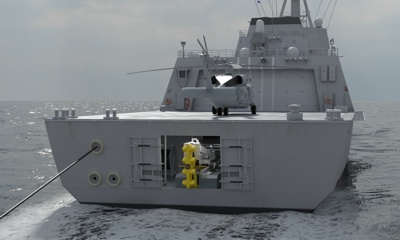
CAPTASThe U.S. Navy currently has outstanding capability in ASW. The challenge is that most of this capability resides in high-end combatants and submarines, such as the DDG 51 Arleigh Burke class and the Virginia SSNs. These platforms are extremely capable but are tasked with multiple missions in addition to ASW. For example, air defense may require the ship to operate near the strike group, while long-range ASW is best conducted well ahead of the strike group. The FFG program was intended to provide relief to this challenge by bringing needed capability focused on fewer areas, such as long-range ASW, at a lower cost.

Long-range, variable depth sonar is among the most-needed capabilities by the Navy and was one of the key requirements of the FFG program. The long-range, variable depth sonar, termed CAPTAS, that was slated to be installed in the FFG is already in service on a number of NATO ships and is uniformly praised for performance. In fact, French ships that have the system won two Sixth fleet Hook EM awards for best ASW performance.

The decision to cancel the FFG program would seem to result in the loss of this capability for the foreseeable future, meaning it will not be available in the desired 2027 timeframe. But the increased emphasis on innovative acquisition approaches may enable a path forward that could provide needed capability earlier and in greater numbers than the original FFG build schedule provided.

Under the FFG program, two of the long-range, variable depth sonar systems have already been delivered to the shipyard, and the third and fourth are now complete and ready for delivery. Contract options for additional units are in place, and facilities exist in the U.S. to build up to five systems per year. The Navy just needs to find a way to get them to sea.

Fortunately, there are platforms that currently exist and are entering the fleet in greater numbers Unmanned Surface Vessels (USVs) as well as commercial vessels of opportunity (VOOs) can support long-range, variable depth sonar operations. The Navy and industry have demonstrated a containerized version of the system, installing and removing it from a commercial supply boat as a proof of concept. With the critical sensor capability decoupled from specific platform build schedules and the adaptability of a containerized system, the Navy has much greater flexibility to acquire and deploy these units.

This is where the established policies for meeting urgent needs, including tools like Other Transaction Authorities emerge as a key enabler to accelerate antisubmarine warfare capacity. Using these levers for accelerated acquisition allows the Navy to rapidly pivot its acquisition strategy, taking advantage of a proven system that they have already procured and getting it to the fleet faster than originally planned.

The cancellation of the Constellation program may ultimately enable the Navy to deliver a critical capability to the fleet more quickly and in greater numbers than the original plan. Variable depth sonar, coupled with the Navy s great work in developing and maturing USV reliability, autonomy and concepts of operation, provides all the pieces needed to make this work. Rapid delivery will take innovative acquisition thinking, imaginative approaches by the contracting community, and a strong commitment to getting the Fleet the capability they asked for. All the pieces are there, they just need to be put together.

ABOUT THE AUTHOR
Vice Adm. Landay graduated from the United States Naval Academy and was commissioned an ensign in 1978. Landay holds a Bachelor of Science in Systems Engineering from the Naval Academy, a Master of Science in Systems Technology (C4I) from the Naval Postgraduate School and is a graduate of the Program for Management Development at the Harvard Business School. As a flag officer, Landay served as the program executive officer for Littoral and Mine Warfare. In January 2006, he became the 21st chief of Naval Research. Landay became director of the Defense Security Cooperation Agency in August 2010 prior to his retirement from active service.

January 21, 2026 – From the Defense Business Brief:

Anybody need a towed sonar array? Thales has been brainstorming how to repurpose some that were designed for the U.S. Navy, but the service canceled the frigate that was supposed to tow them. It’s a situation that could befall other defense companies as Pentagon leaders urge nimble acquisition and insist that suppliers take on more risk. Thales delivered two Compact Active Towed Array Systems to Fincantieri before the Constellation-class program was suddenly axed in November. The systems are now stored in warehouses, and parts for four more are on standby, Tony Lengerich, vice president for naval programs at U.S.-based Thales Defense & Security, told Defense One. Lengerich says the sensor system—already installed on 50 NATO-member ships—could be attached to drone boats controlled by a “joystick and a button.” The company is working with companies competing for the Navy’s fast-attack USV programModular Attack Surface Craft, to bring the idea to bear.  “We’ve already demonstrated the capability to put it at sea on a not-gray-hulled vessel,” said Lengerich, a retired rear admiral and surface warfare officer. “We could do this tomorrow. This is not something new.” It’s an example of how defense companies are handling pressure from the White House, and Pentagon, to take on more risk and self-fund new technology needed for war. “Overall, the big theme for what we’ve been trying to interest the Navy in follows the Navy’s operational concept of Distributed Maritime Operations,” Lengerich said. “In an anti-submarine warfare context, you also need to distribute sensors that would find submarines and detect them early.”  Since there’s arguably an operational need, let’s see if the Navy likes the idea of putting them on USVs—or maybe even the new frigates.

December, 2025

New Generation of Sonobuoy Technology for a New Threat Environment

For more than four decades, the U.S. Navy has relied on the SSQ-62 Directional Command Active Sonobuoy Sensor (DICASS) for short-range, high frequency active detection. Modern submarines are quieter, harder to detect, and operate at greater standoff ranges than ever before. The legacy sonobuoys have only marginally improved and no longer provide the reach or flexibility required for today’s contested undersea environment.

Introducing MCAPS: Three Times the Detection Range

The Medium-Frequency Combination Active Passive Sonobuoy (MCAPS) represents a decisive leap forward in U.S. Navy Anti-Submarine Warfare (ASW) capability. Compared to legacy SSQ-62 buoys, MCAPS delivers:

  • 3x the detection range. Thanks to a modern advanced transducer, enhanced receive array, and next-generation battery system.
  • Advanced active waveforms. Including both Continues Active Sonar (CAS) and traditional single-pulse transmission to improve recognition and tracking in contested environments.
  • Integrated passive capability. MCAPS provides a narrowband passive acoustic capability, similar to the Navy’s SSQ-53 DIFAR buoy, which offers an increased detection range.

MCAPS is the only sonobuoy for ASW that provides active and passive acoustic capabilities at greater ranges than the U.S. Navy currently employs. Combining these features into a single sensor offers more flexibility for operators. It simplifies mission planning, and expands tactical options while reducing aircraft loadout, logistics complexity, and training burdens.

Doing More with Fewer Buoys: Cost Effective Modernization for a Demanding Fleet.

Sonobuoys are expendable, high-volume consumables. The U.S. Navy deploys approximately 250,000 buoys each year, more than all other nations combined. Using fewer sensors that deliver greater detection range is not only operationally advantageous, but also fiscally strategic.

With MCAPS, aircrews can detect, classify, track and if needed, prosecute submarines from greater distances and outside threat envelopes. Its extended range means fewer sonobuoys needed per field, reducing cost per mission and enabling the Navy to stretch its inventory further during periods of increased operational activity.

Additionally, MCAPS is built to NATO standards and is a perfect fit for worldwide coalition interchangeability, interoperability, and cooperative engagement against common targets of interest.

Strengthening America’s Industrial Base

Advanced Acoustic Concepts (AAC) has the ability to answer the Navy’s call to produce the needed inventory of sonobuoy technology now. Because of the high Technical Readiness Level (TRL), MCAPS will be fast to market while the Navy will experience cost avoidance for development and overall sustainment costs.

AAC, a Thales-owned company, is currently evaluating U.S. based manufacturing locations including existing Thales facilities to expand production capacity, create technical jobs, and further strengthen the U.S. supply chain resilience.

Testing & Demos Underway

MCAPS is currently being evaluated by the U.S. Navy and international partners. Stay tuned for details on upcoming demonstrations and operator engagements in mid-2026.

November, 2025

CAPTAS VDS: French Frigate wins US Navy’s “Hook ‘Em” Award

From Xavier Vavasseur at NavyNews.com

The French Navy (Marine Nationale) FREMM frigate Aquitaine won the U.S. Navy’s “Hook’em” award. This marks the fifth time that the U.S. 6th Fleet awards the price to a French unit for its ability to find and track submarines (and the fourth time to a FREMM frigate)

The “Hook’em Award” rewards Anti-Submarine Warfare (ASW) excellence. It is presented quarterly to a unit supporting U.S. Navy’s 6th Fleet (also known as US Naval Forces Europe) which has demonstrated superior ASW readiness, proficiency, and operational impact.

Vice Adm. Frederick C. Turner established the “Hook ‘Em” award in December 1975 to recognize 6th Fleet’s ships, submarines, and aircraft squadrons demonstrating ASW excellence. The award was discontinued two decades later, but it was reestablished by Adm. James G. Foggo III in 2016 during his tenure as Commander, US 6th Fleet.

A French Navy Atlantic Command (CECLANT) post on LinkedIn published on March 11, reads:

The crew of the multi-mission frigate (FREMM) Aquitaine receives the “Hook ‘Em award”, the excellence prize of the 6th American fleet in anti-submarine warfare !

This award of excellence was presented in Naples by Commodore Doug Sattler (CTF 69) to the commander of crew B of the FREMM Aquitaine, for the performance of his unit during anti-submarine operations in the North Atlantic during the year 2025.

Usually awarded to American units, this quarterly prize created in 1975 is once again given to a French unit. It thus marks the recognition of French know-how and the high degree of confidence accorded by our American partners, in a particularly strategic area for the security of allied operations in the Atlantic.

The ultra-performing sensors and information processing, analysis and intervention capabilities of the FREMMs and their embarked Caïman Marine helicopter make them formidable submarine hunters.

Trained and skilled, the crews of the Navy have acquired expertise to deploy them in operations. They are now recognized as among the best in the world.

Fourth time a French FREMM frigate wins the award

Back in 1991, the 21F flotilla, stationed at Nîmes-Garons naval air base and flying Atlantique Maritime Patrol Aircraft won the award.

In 2020, French CTF 470 and 473 and French frigates FS Bretagne (D-655) and FS Auvergne (D-654) earned the recognition.

In 2021, Admiral Eugene Black, then Commander of the U.S. 6th Fleet based in Naples, rewarded three French units including two FREMM frigates: CTF 473, FS Provence and FS Languedoc.

In 2022, Vice Admiral Wing Ishee (C6F) presented the award to Vice Admiral Boidevezi, Commander Task Force 470 (CTF 470) and FREMM frigates Auvergne , Bretagne , Languedoc and Provence, for their deployments in the Mediterranean in coordination with the United States Navy.

Naval News understands the American choice to procure the Thales CAPTAS-4 variable depth sonar system (fitted aboard all French FREMM frigates) for the (now cancelled) Constellation-class frigate program was directly related to feedback from U.S. Navy Europe on the performances of this sonar.

October 1, 2025

Naval Air Systems Command (NAVAIR) Patuxent River, MD, intends to negotiate a contract to Advanced Acoustic Concepts, LLC (AAC) on an other than full and open basis. NAVAIR intends to procure upgrades of software/hardware and improvements of CASEFI to support UnderSea Advantage (USA), Automated Directional Command Activated Sonobuoy System (AutoDICASS) and Acoustic Communications (ACOMMS) on Maritime Patrol Reconnaissance Aircraft (MPRA). This requirement seeks to propose, refine, and enhance CASE-FI to contain new capabilities and sensors to support acoustic systems development and training. The anticipated period of performance for this action is five years which includes options.

September, 2025

Earns CMMI Maturity Level 3 Appraisal for Development Excellence

CMMI Maturity Level-3Advanced Acoustic Concepts (AAC) announced it has been appraised at Maturity Level 3 of ISACA’s Capability Maturity Model Integration (CMMI) for Development. This prestigious achievement, conducted by an independent appraiser, underscores AAC’s dedication to process excellence, continuous improvement, and delivering high-quality solutions to its customers.
CMMI Maturity Level 3 indicates that AAC operates at a “defined” level, where processes are well-characterized, standardized, and proactively managed across the organization. This milestone validates AAC’s robust frameworks for software and systems development, ensuring enhanced efficiency, reduced risks, and superior performance in mission-critical projects.

“We are thrilled to achieve CMMI Level 3, a testament to our team’s hard work and commitment to innovation in undersea warfare technologies,” said Robert Olsen, Vice President of Operations. “This appraisal reinforces our ability to provide reliable, cutting-edge solutions that support the U.S. Navy and our defense partners, while fostering a culture of continuous improvement.”

AAC has a proven track record of integrating Commercial Off-The-Shelf (COTS) processing with advanced sonar and sensor systems since 1989. This certification positions the company to better meet evolving customer needs in a dynamic defense landscape.

June, 2025

Secures Major Naval Contract for MK48 Torpedo Components

MK-48
AAC’s Lemont Furnace facility has secured a significant sole source contract with the Naval Undersea Warfare Center Division Newport to manufacture, test, and deliver critical components for the MK48 torpedo program supporting Foreign Military Sales partners. The Mark 48 torpedo is the Navy’s primary heavyweight submarine-launched torpedo, designed for both antisubmarine and anti-surface warfare. AAC will provide crucial subsystems that ensure precise detonation sequencing and reliable target acquisition. The innovative transmitter technology enhances target discrimination in challenging acoustic environments, giving the MK48 superior performance against sophisticated countermeasures.

This Cost-Plus Fixed Fee contract, valued at approximately $137 million over ten years, covers production of MK48 Sonar Transmitters, Warhead Electronic System Function Item Replacement Units, and the Transmitter Test Station, along with engineering for custom test equipment and support services.

MK-48
“This award recognizes our team’s technical excellence and manufacturing precision,” said Michael Rubish, MK48 Business Line Manager. “Being the only qualified manufacturer for these critical systems demonstrates our unique capabilities in underwater weapons technology.”

AAC earned this sole-source designation after First Article units successfully completed rigorous qualification testing. The Navy determined that qualifying another source would cause unacceptable delays in fulfilling requirements.

The contract includes both development and initial production phases, positioning AAC for additional opportunities in underwater systems and demonstrating their competitive strength in the naval defense sector.

Production will be managed through the Lemont Furnace facility. This program will maintain stable employment for engineering and production teams while strengthening AAC’s position as a key supplier to Navy underwater weapons programs.

March, 2025

U.S. Navy Witnesses SonoFlash Sonobuoy Demonstration

SonoFlashThe SonoFlash mid-frequency combination active/passive sonobuoy Critical Design Review (CDR) was held the week of December 2, 2024. AAC representatives traveled to Sofia, France to witness briefs and an in-water acoustic test at Lake Castillon Reservoir. They were joined by Shawn Horigan, OPNAV N98 Air Warfare Division Sonobuoy Requirements Officer. The briefs and demonstration were conducted by both the French Direction Générale de l’armement (DGA) Program Director and Technical Director of Thales Program Management and Engineers.
SonoFlash has achieved a Technology Readiness Level (TRL) 7 and is ready for further evaluation and consideration by the U.S. Navy for deployment from the Anti-submarine Warfare (ASW) aircraft P-8A Poseidon and MH-60R Seahawk.

SonoFlash provides 3 times the active detection improvement over current U.S. Navy sonobuoy sensors, and offers interoperability with other mid-frequency sonar systems in a multi-static operation, such as the ALFS dipping sonar and CAPTAS sonar systems. Planning is ongoing to transition the SonoFlash technology to the U.S. where AAC will lead the modification, test, and manufacturing of the capability.

February 29, 2024

Thales successfully delivers the first CAPTAS-4 sonar for the US Navy
CAPTAS-4

  • Advanced Acoustic Concepts (AAC), a subsidiary of Thales, has delivered the first CAPTAS-4 sonar for the U.S. Navy’s Constellation class Frigates (FFG). Prime contractor Fincantieri Marinette Marine (FMM) awarded the contract in May 2022.This delivery demonstrates the efficiency and the expertise of Thales’ solutions and services.
  • The CAPTAS-4 variable depth sonar (VDS) has successfully completed all the milestones in the program established with FMM. The first system is currently in the United States ready for installation on the first Constellation-class Frigate (FFG-62). ​
  • The CAPTAS-4 system, which has won several awards for its unrivalled performance in underwater warfare coalition exercises, will help the new U.S. frigates to detect, locate, classify and track increasingly stealthy submarines.

The first CAPTAS-4 variable-depth sonar transmitter has been delivered to the U.S. Navy’s Constellation Frigate Program (FFG-62). This delivery, ahead of schedule, demonstrates the effectiveness of Thales as a trusted partner to worldwide navies. The U.S. Navy will benefit from the demonstrated reliability and performance of the CAPTAS-4, the undisputed market leader in underwater variable depth active systems.

AAC delivered the system on Oct. 12, 2023, ahead of contractual milestones while under very aggressive time constraints. Thales’ unrivalled sonar technology was chosen by Fincantieri Marinette Marine, in agreement with the U.S. Navy to equip its new frigates. In addition to the two systems already ordered to date, up to eight additional CAPTAS-4 transmitters assemblies could be supplied under the current contract. ​ In this perspective, in April, AAC will complete construction on a new CAPTAS production facility located at their current site near Uniontown, Pennsylvania, where final assembly, integration and acceptance testing will occur for shipsets two through 10.

Thales has more than 50 years’ experience in underwater warfare and is the world’s leading sonar exporter. The CAPTAS family comprises a series of low-frequency variable-immersion sonars dedicated to anti-submarine warfare. The CAPTAS-4 delivered to the U.S. Navy is the most powerful of the CAPTAS family. It has been tested under a wide range of operational conditions for instance by the French, British and Italian navies, and its technical maturity and performance are recognized the world over.

In 2020, 2021 and 2022, several French multi-mission frigates equipped with the CAPTAS-4 system won the prestigious Hook’Em Award, the American prize for excellence awarded to the best crew performance in the field of anti-submarine warfare, during coalition exercises in the 6th Fleet area of operations. Thales was singled out and recognized for the excellence of its know-how, for the ability of its sonar systems to detect, locate, classify and pursue increasingly stealthy and silent threats under the sea.

“Thales is a long-time supplier of advanced and capable ASW systems to the U.S. Navy and major U.S. prime contractors. With this new contract for the delivery of CAPTAS-4 variable depth sonar, they are once again demonstrating the performance of our acoustic systems and renewing their confidence in our teams,” said Gwendoline Blandin-Roger, Vice President, Underwater Systems, Thales.

“Advanced Acoustic Concepts is proud to announce that we have successfully delivered the first CAPTAS-4 variable depth sonar system for the U.S. Navy’s FFG-62, the first of the new U.S. Frigate class,” said Mike Carnovale, President and CEO of AAC. “We look forward to further serving the U.S. Navy as we continue to supply and support this critical ASW capability well into the future.”

AAC’s History

Jan 23, 2026

2023

AAC adds a new facility at its Pennsylvania campus location for the assembly, integration, and testing of the CONSTELLATION Class Frigate’s Variable Depth Sonar (VDS) ASW system

Jan 23, 2026

2022

AAC becomes a U.S. FOCI mitigated, wholly owned subsidiary of the Thales Company

Jan 23, 2026

2021

AAC expands its Pennsylvania manufacturing capacity to accommodate rapidly growing production demand

Jan 23, 2026

2019

AAC celebrates its 30th Anniversary

Jan 23, 2026

2018

AAC participates in US Navy’s Advanced Naval Technology exercise, demonstrating capabilities largely possible via AAC’s SAMDIS imaging sonar and ANGLER underwater weapon system

Jan 23, 2026

2016

AAC recognized at Navy Employer Recognition Event

Jan 23, 2026

2015

AAC receives Lockheed Martin Supplier of the Year Award

Jan 23, 2026

2011

AAC becomes joint venture acquisition between DRS (Leonardo) and Thales Underwater Systems

Jan 23, 2026

2007

AAC forms partnership with Lockheed Martin to execute the AN/SQQ89(V) Surface Ship ASW Combat System Program as a key player

Jan 23, 2026

2006

Improved Performance Sonar (IPS) transitions to Scaled IPS Program of Record; Integrated COTS processing into ASW Combat Systems supporting Rapid Capability Insertion

Jan 23, 2026

2005

NAVAIR awards AAC contract for Common Acoustic Simulation Environment for Air ASW fleet

Jan 23, 2026

2001

Company expansion to include Engineering and Production Facility in Pennsylvania

Jan 23, 2026

1999

Company expansion to include Advanced Research Facility in Maryland

Jan 23, 2026

1990's

Sparsely Populated Volumetric Array (SPVA) – Successful transition from Phase 1 Investigation to Phase 3 Production

Jan 23, 2026

1990

AAC’s Acoustic Simulation program initiated the core of our leadership in Underwater Acoustic Simulation

Jan 23, 2026

1989

Founded in Ronkonkoma, NY